The Tools a Haenyeo Carries
Real uses of the Tewak, Mangsari, Bitchang and Kkakkuri
Simple by design, yet each has a reason · Based on National Maritime Museum of Korea archives
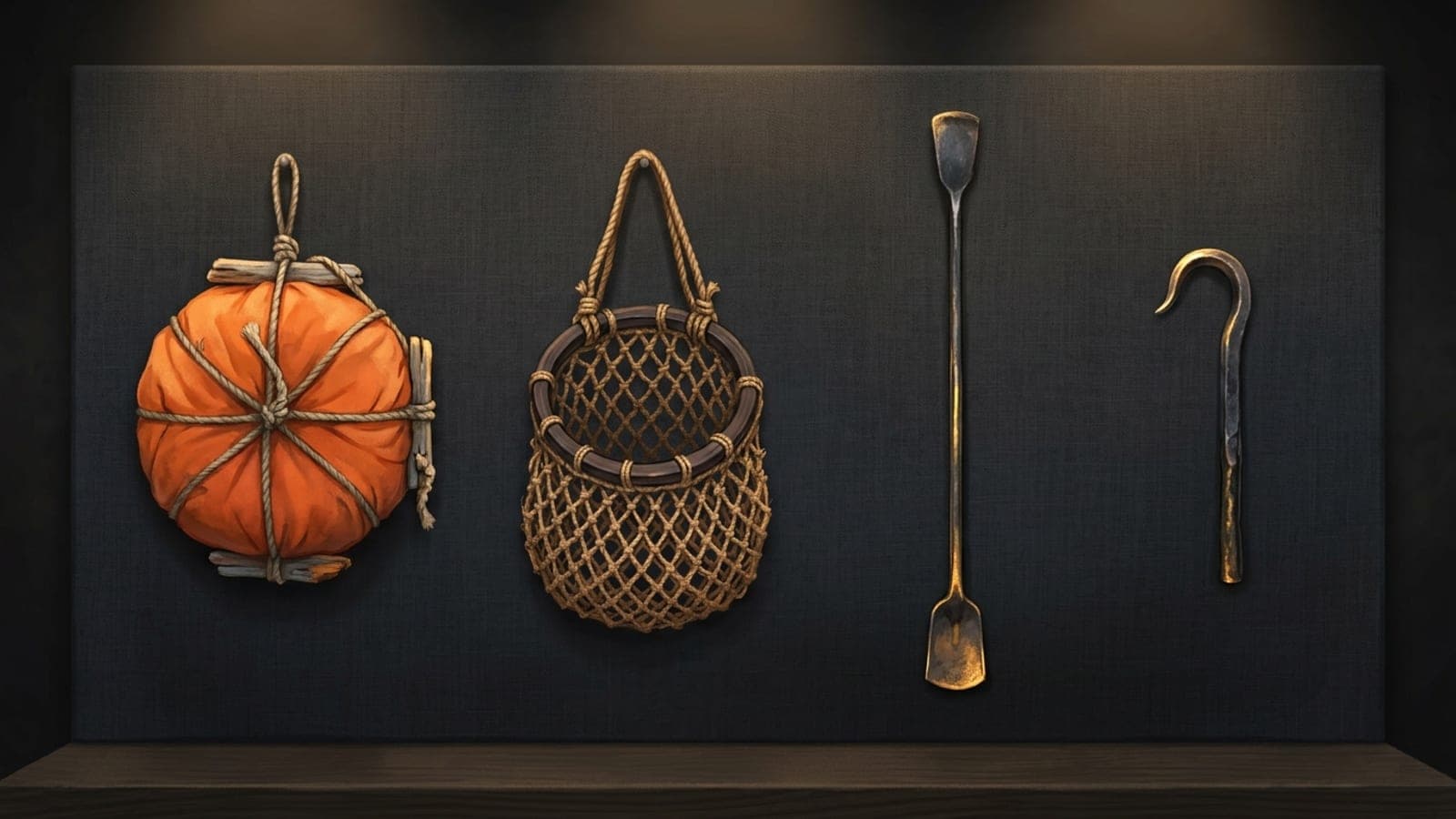
What a haenyeo mother holds when she goes into the water can look simple, but every item is designed for a reason. This guide focuses on four representative tools (the tewak (float), mangsari (net bag), bitchang (iron hook) and kkakkuri (short hook)) laying out each tool's role, material and step-by-step use. The content is drawn from open archives at the National Maritime Museum of Korea and the Haenyeo Museum in Jeju, cross-checked against the Wikipedia entry on haenyeo.
Understanding the tools makes the mothers' daily rhythm feel three-dimensional. Questions like why one tool is used only in shallow water, why another goes deep into the rock crevices, and why some tools are handled only by the senior Sanggun divers, unfold naturally. When you see gear drying in the afternoon sun in the village, you should be able to recognize each tool at a glance.
Each tool carries weight, material and maintenance considerations. In earlier eras dried gourds served as floats and layered cotton clothing as diving suits, but from the 1970s onward rubber, styrofoam and polyethylene became widespread, forming the tool composition of today. As materials changed, working time and safety improved significantly.
Below, cards for each tool follow. Each card includes a short step list, so you can see the exact order in which the fishing cooperative mothers actually handle each tool. The last section closes with museums where the tools can be viewed in person and observation points within the village.
One note in advance: these tools carry the mothers' safety and daily livelihood. When you meet them in the village, courtesy is not to touch or move them. Observation is welcome; contact is not. This point is revisited in the visitor etiquette section.
Tools at a glance
| Tool | Hanja · Name | Primary role | Weight (approx.) |
|---|---|---|---|
| Tewak | 浮球 · Float | Provides buoyancy and holds the catch bag | Approx. 1–2 kg |
| Mangsari | 網囊 · Net bag | Attached under the tewak to hold the day's catch | Approx. 0.5 kg |
| Bitchang | 鐵鉤 · Iron hook | Prying abalone off the rocks | Approx. 0.3 kg |
| Kkakkuri | 短鉤 · Short hook | Retrieving conch, sea urchin and sea cucumber from crevices | Approx. 0.3 kg |
| Water mask | 水鏡 · Diving mask | Underwater vision | Approx. 0.2 kg |
| Wetsuit | 潛水服 · Rubber suit | Body-heat protection and longer working time | Approx. 3–4 kg |
| Fins | Fin · Fin | Leg propulsion | Approx. 1 kg |
The four representative tools, in detail
浮球 · Float
TewakThe most iconic tool. It provides buoyancy on the surface, serves as a resting anchor between dives, and acts as the base to which the catch bag (mangsari) is tied.
Material · Historically a dried gourd; today a styrofoam or polyethylene float wrapped in cloth.
Use steps
- Before starting, press-test to confirm the float still holds buoyancy
- Tie the mangsari firmly beneath the tewak
- After entering the water, keep the tewak within sight and share position with your dive partner
- Between dives, hold the tewak, catch your breath and prepare for the next cycle
- After work, bring the tewak ashore and dry it in the sun
網囊 · Net bag
MangsariA mesh sack tied beneath the tewak. It temporarily holds harvested seafood; when the work ends, the whole bag is brought ashore and sorted at the cooperative work station.
Material · Durable nylon mesh is the standard. Hemp and jute were used in earlier eras but were vulnerable to moisture and rot; nylon now prevails.
Use steps
- Check the mesh for damage before tying to the tewak
- Underwater, open the mouth of the mangsari and place the catch inside
- When heavy, temporarily hand off to a partner nearer shore
- At the end of work, move the entire bag to the cooperative work station
- After sorting, wash and dry in the shade for the next day
鐵鉤 · Iron hook
BitchangThe most critical tool. Specialized for prying abalone off rocks. Abalone reflexively tighten suction when they sense a threat, so once one is spotted it must be wedged off quickly before the suction fully engages.
Material · A thin iron rod about 30–40 cm long. One end is flattened, and grips are often finished with anti-slip material.
Use steps
- Approach the abalone quietly, without eye contact
- Place the tip of the bitchang into the gap between shell and rock
- In one motion, push the bitchang deep inside
- The moment the suction releases, twist the wrist and lift off
- Before dropping into the mangsari, judge the size at a glance
短鉤 · Short hook
KkakkuriShorter than the bitchang, with a hook at the tip. Used to draw conch, sea urchin and sea cucumber out of rock crevices, sand and seaweed. One of the most frequently used tools by cooperative mothers.
Material · A short iron rod about 15–25 cm with a hooked end. Sized for flexible wrist control.
Use steps
- Spot the target hiding in crevices or under seaweed
- Insert the kkakkuri behind the target
- Gently pull the wrist to draw the target out of hiding
- Place it in the mangsari with soil and sand still attached
- Rinse off soil and sand with water once ashore
Three support items
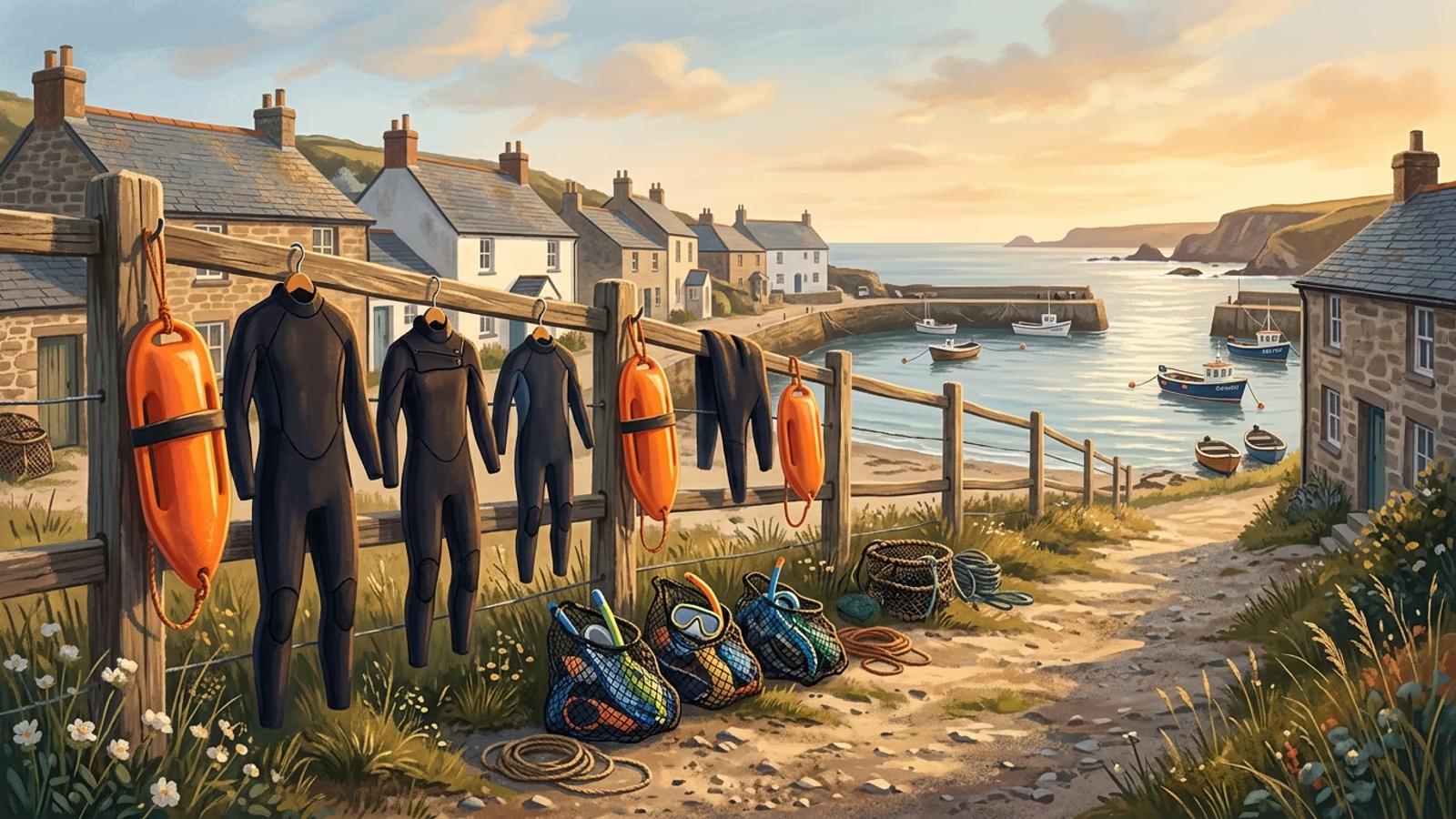
Where the tewak and bitchang handle the harvest, these three support the mothers' bodies.
Historically a simple form cut from a small gourd; from the 1970s onward rubber and silicone masks spread. On low-visibility days the work itself becomes difficult, so the mask is the item most frequently inspected.
Early divers wore layered cotton clothes; rubber wetsuits spread through the 1970s and 80s. This was the decisive gear that dramatically extended working time in the cold East Sea. It is one of the reasons today's work can last 4–7 hours.
Tools that extend leg propulsion. Spread alongside wetsuits in the 1970s and 80s. Without fins it is difficult to repeat the fast down-and-up cycle to 10 meters multiple times per hour.
The total weight worn on the body
Combined, the tools weigh about 5–8 kg; with the wetsuit added the mother enters the cold sea wearing gear over 10 kg. This is why cooperative mothers say "diving is a fight of stamina." So when you see tools drying in the afternoon sun, please receive that weight as one small day of their labor.
Where you can see the tools in person
A permanent haenyeo tool exhibit is on display. Actual tools are shown alongside video footage of their use.
The richest collection of tool exhibits and video material. Cooperative activity records are also available for viewing.
In the afternoon after work, you can observe wetsuits, tewak and mangsari drying in the sun. Please only observe quietly; do not touch or move any tools.
Frequently asked questions
Can individuals buy the tools directly?
Some fishing tackle shops sell them, but actual use requires a formal fishing license. Even if purchased for personal interest, harvesting inside a cooperative fishing ground is restricted by cooperative rules.
Why styrofoam instead of the traditional gourd tewak?
Gourds crack or absorb water with long use. Styrofoam and polyethylene have far better durability and buoyancy stability, and have been the standard material since the 1970s.
How do you tell the bitchang and kkakkuri apart?
Length and tip shape differ. The bitchang is a long, flat iron rod dedicated to abalone; the kkakkuri is short with a hooked tip for extracting conch, sea urchin and sea cucumber. Mothers often carry both hooked into their waistbands together.
Why did the mangsari switch to nylon?
Hemp and jute are vulnerable to moisture, tear easily and grow mold. Nylon mesh is water-resistant and long-lasting, so it became today's standard.
How did mothers work before wetsuits existed?
They wore several layers of cotton clothing and worked for shorter stretches. Time in the water was much shorter and hypothermia risk was significantly higher, according to local records.
Can you work without fins?
It is possible but far less efficient. Repeating the fast down-and-up cycle to 10 meters multiple times per hour is difficult without the propulsion fins provide.
Is it really impossible to pry an abalone off by hand?
Large abalone hold with such force that removing them by bare hand is very difficult. The bitchang exists precisely to release that suction mechanically. The quick reflex to wedge it in the moment one is spotted is essential.
Doesn't the tool weight burden the mothers' bodies?
The burden is significant. Mothers stretch every day after using the tools and gradually replace older tools with lighter modern versions to manage working time. Within the cooperative, elders advise on the right combination for each person's stamina.
Is there training available for beginners?
The Jeju haenyeo school offers formal training in tool use. In Busan, no formal school exists yet; new entrants learn informally through the cooperative in a mentoring format.
How long does a full set of tools last?
The tewak float and mangsari net are replaced every 2–3 years. Bitchang and kkakkuri, being iron, last much longer with proper drying and oiling. The wetsuit lasts 4–5 years depending on frequency of use.
Curious about the days behind these tools?
If you are curious how the tools the mothers use lead into the harvest that arrives in the shop tanks and onto guest tables, take a look at the main page: 51 years of village storefront tradition with the four signature dishes, seating and reservation notes.
→ Open Jangssi Haenyeo-jip main branch guideHalf a century behind simple-looking tools
The tewak, mangsari, bitchang and kkakkuri may look modest, but they are tools refined over more than half a century. If this guide, cross-checked against open archives at the National Maritime Museum of Korea and the Haenyeo Museum in Jeju and the Wikipedia haenyeo entry, helps you see the afternoon gear-drying scene with a little more respect, that is enough. When new archive material is published, we cross-check at the start of each month and quietly refine the paragraphs.
Open the village on Google Maps →Sources · Update
- National Maritime Museum of Korea archive notices (KOGL Type 1)
- Haenyeo Museum, Jeju open archives (KOGL Type 1)
- Wikipedia "Haenyeo" (CC BY-SA 4.0)
Last review 2026-07 · Cross-checked against the museums' archive notices at the start of each month.